
Reverend Mother’s hand is dry as paper as it grips mine. The train belches smoke into the crisp air.
“Are you sure about this, Peggy?”
My throat is tight. I have reason to be so grateful to her. “I just can’t let Noah go alone.”
Reverend Mother’s habit sweeps the platform as she turns to him. “Noah, haven’t we kept you safe? Why do you need to go?”
Noah shakes his dark head, he traces Reverend Mother’s wimple, his piano player fingers skirting the outline of her face until his hand comes to rest on her shoulder. He stares at her as if he can see her.
“I’ve told Sister Margaret, Reverend Mother, she doesn’t need to come. The way is too dangerous… Yet”
He clicks his tongue against his teeth, like the clicking of fingers. He turns as the sound bounces from the train and he steps towards it.
“To be so close to the Spanish border, so close to freedom and,” his hand balls into a fist, “I can’t stay in The Convent forever. Every day I stay you are in danger. And,” His Head nods towards me, as he senses where I’m standing, “Sister Margaret, don’t risk anything for me. Here’s the train. See, even without your eyes, I know it’s exact position.”
The Pyrenees are snow-capped even though celandines shine a brave yellow from the banks that edge the railway line. The sun sets behind the highest peaks and cold skins my face. My scarf smells of incense as I pull it up over my mouth.
The guard blows the whistle one last time.
“All aboard for Somport and Canfranc Station.”
Canfranc Station, in the Spanish Pyrenees, this railway, the line to freedom for Noah, and for me? Perhaps.
Everything has changed since Noah, the piano tuner, arrived at the convent door. While tanks rumbled through the streets outside our walls, his fingers felt their way across the piano’s keyboard in the marble chapel. When he played Chopin’s Number 1 the music soared through me so that my soul was an eagle flying high over the Pyrenees.
Noah grasps Reverend Mother’s hand. “I’ll always be grateful.”
“Sister Margaret was right, Noah.”
I see again the rows of veiled heads nodding as I begged them for sanctuary for him. All Reverend Mother said was that his playing was a prayer to God.
“Next year I’ll be twenty. Margaret,” he turns to me as if he can see me too. “Do I need a novice only a few months older than me risking her life mothering me?”
“Noah, you can’t see what is on that flag can you?” I point at the town hall in the square bordering the station and the flag with the swastika on it.
“I’m not a child.”
My voice sounds waspish even to me. “But you need a pair of eyes that can see dangers you cannot.”
Reverend Mother’s hand is a vice on mine now. “I’m always here for you, Peggy. God keep you both safe.”
Noah feels his way to the door and into the carriage. The train’s funnel blasts and smoke billows into the air, the door handle cold in my palm as I follow him, the door slamming shut behind us.
Reverend Mother raises her hand, and whether it is in farewell, or whether it is a blessing I don’t know.
A screech of brakes and a jeep skids to a stop outside the station railings. My heart thumps. Reverend Mother? But she’s gone.
An SS captain jumps out, his holster bulging from his side, three men behind him. Their boots pound onto the platform. My mouth is dry, nausea rises in me as they rush towards the guard, guns aimed towards the train. Noah faces the tunnel before the border, his face tense. The tunnel that could take us to freedom.
The train guard and the captain both gesticulate like a pair of fighting hares. The guard lowers his red flag and it’s as if the train exhales as I do when it picks up speed and rattles out of Urdos. The soldiers pound down the platform to its end. The final station in occupied France behind us now.
The darkness of the Somport tunnel envelops us. My palms slicked with sweat. They could order the train to stop, even now.
But the train judders on until pinpricks of light pierce the blackness at the end of the tunnel before they swell into station lights. We slow down as we leave the tunnel.
Canfranc station is as grand as a palace. The snow on the mountain tops glows under the moon.
Our footsteps echo on the frosted platform. Noah traces Canfranc Estación on the sign as we stand before it.
“We made it Noah. You’ve got your freedom.”
“And you?” he says, “Have you got yours?”
The air is sharp on my head as I tuck the veil into my bag. That raw air stings my bare neck. The mountain range is a dark silhouette but in my mind I picture sunlit days and eagles soaring around snow-capped peaks.
How it came about:
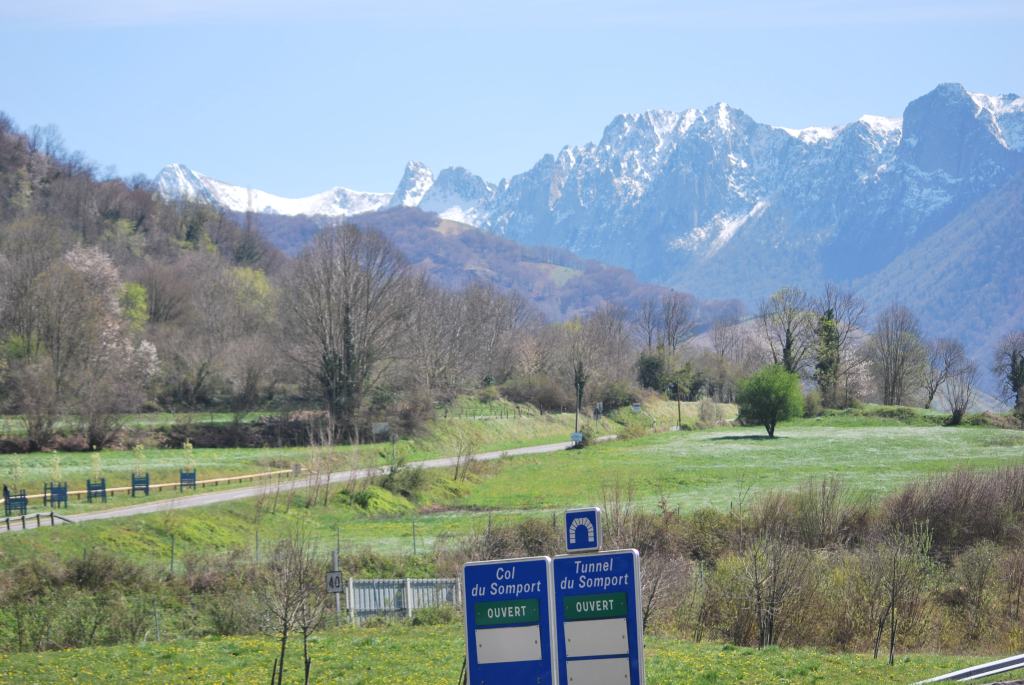
This piece came about as we crossed the Pyrenees in our camper through the Somport Tunnel. Canfranc Station is so grand and imposing and a quick google told me that it was a point of freedom for refugees in World War II. Railway stations have always been full of romantic possibilities for me, so many farewells, so many meetings. It was at Canfranc Station that Noah, the blind piano tuner came into my mind.
Travelling unlocks so many new potential stories for me. It doesn’t have to be grand travelling either, sometimes it can just be a train journey to London or a bus journey. Somehow the movement from place to place unfetters the mind and, if you’re as nosey as me, allows you to ponder the multiple lives swarming around us.
All writing has autobiographical elements in it, even if events or people are not strictly factual, there is a kind of truth from our own lived experiences which enters the writing. Educated by nuns from the age of 5 to 18, and afterwards, working with some nuns who were amazing characters in my first teaching job, nuns have always interested me. When I worked in a convent school in London, a group of 18 to 20 year old novices visited us and performed a mime at assembly.
One of the young women told me she’d entered the convent because she admired the nun who was her History teacher at school. I myself was influenced a great deal by Sister John who taught me Geography. She was so gifted, everything was taught through stories. I still remember the rhyme that taught us the course of the River Rhine.
I’ve thought a great deal over the years of how 18 is too young to choose anything and so I played my ‘What if?’ game with Peggy. What if her mother had died and Reverend Mother took her place? What if there was a need for freedom inside Peggy when Noah made her realise that there was a big world outside of the Convent walls?
It was on my rewrites though that I edited out the sections looking back at Peggy’s life in Ireland and the loss of her mother. I wanted more of the ‘snapshot’, in-the-moment feeling, of a piece of flash fiction. As usual, I also had to edit a great deal out where I was ‘telling’ too much, including the ending where I explained about her sense of lightness when she’d left the convent behind. Instead I left the reader with an image of eagles soaring over the mountain range.
This editing process was influenced by Nancy Stohlman and her very useful, succinct ‘Going Short – An Invitation to Flash Fiction’ – and her chapter entitled ‘Erasure: Loaded Silences and Intentional Ghosts’. Here she recommends cutting out the overtly stated and emphasises the importance of gaps and silences. An example she gives is a whole story in six words by Nick Busheff. ‘FIRST DATE’ – ‘At the opera, she chugged beer’.
These six words say so much about the cultural expectations of each character on that first date, but leaves us to decide whether the protagonist liked his date chugging beer at the opera or was horrified by it. We assume they went on to have more dates, as this one is called the ‘First’, so we wonder whether the behaviour of his date continued to be an irritation or a joy. These six words remind the writer that we can say all we need in less words than we think. This is especially important for me as I have a tendency towards verbosity.
I used a tragic moment in France’s history to explore the motivations of these two young people, the ties that bind them and their struggle for freedom and self-knowledge.
If you want to have a go:
- Go on a train journey – it may be close to home or faraway. Research and choose a station that may be of interest to you.
- Write an account of your journey, using all five senses and noting anything that captures your imagination. It may be an overheard snippet from a conversation. It may be a building or natural environment out the window.
- Research an event in history which could have occurred at this place.
- Play the ‘What if?’ game. ‘What if character X meets character Y in this place?’ The possibilities are endless.
- Let these ingredients cook for a while, but don’t wait too long before producing your first draft. Remember, it’s only a first draft – and no one but yourself needs to see it until you’ve edited it and want to share it, so don’t be intimidated by the blank page. Sometimes I find it useful to set a timer and bash out a first draft in an hour, so it doesn’t eat too much into my day.
- Have fun playing the ‘What if?’ game.
 campervanbard
Leave a reply to The Somport Tunnel to Zaragoza – Campervan Therapy Cancel reply