
Father’s dark head almost touches the fox colour of the estate manager’s head, the ledger full of spider writing in front of them. Perhaps I’ll escape without his notice.
His voice booms. “One hundred sheep lost to wolves. Fine the shepherds. They’ll soon learn not to waste my money.”
In the hallway, the bust of Vasco Da Gama stares at me, the gilt edged painting of Bethlehem fills the whole wall. The memory of Antonio’s dark kitchen, a cave in the cliff, flickers through my mind. Antonio, his books held up to the sun, him squinting over them in the cave’s doorway.
The warm sun coming through the open door is within my grasp.
But Father’s shadow blocks it out. “Joao, tell the monk I wish to meet with him.” His face flushes. “He should not waste his hours helping your nurse’s whelp parse Latin and certainly not at the same time as you, My Son.”
Nurse’s whelp. The same breast fed us. The same lap held us. The same heart beat into us both.
Father’s face softens. “Joao, a man should know his place.” His hand is heavy on my shoulder. “It is kinder to help Antonio accept the life of a shepherd, for that is his future.”
At last. Air. It smells of hot pine. The door slams behind me as my feet pound down the drive, cypresses stabbing the sky either side of it. Dust stains my shoes the colour of dried blood.
The monastery gleams white in front of me, my chest is tight, sweat plasters my fringe to my forehead. Brother Francisco’s study is cool, the light shining through the window making a small square on the tiled ground.
Antonio grins. “My friend,” is all he says before his curly head bends over the Latin again, soil under his nails as he holds the quill.
Brother Francisco’s robes swish along the floor as he hands me the exercise, pats my head. “Try your best, Joao. Antonio will help.”
A dove warbles through the window. Antonio, as always, glances at my work, his quill changing ‘Tu ese’, to ‘Tu es’ before his races through the exercises again. The only sounds the dove, and the scratch of quills on parchment.
When the door thumps into the wall, it is as if the air has been sucked out of the room. Father’s bulk fills the doorway.
“Brother Francisco, a word.”
Brother Francisco smiles. “Perhaps we should step outside, Your Grace.”
“There is no need for secrecy. My son’s lessons must not be compromised by… the shepherd’s lad.” He sighs. “I mean no harm, Antonio, but the mark of a man is to know his station. The mark of a boy is to learn it.”
Brother Francisco’s fingers are ink-stained. Antonio’s parsing in his hand. “See, Your Grace, such talent.” Brother Francisco’s smile is wide. “Joao, may I?”
My voice is unsteady, “See Father, the corrections, they are in Antonio’s hand. He helps me.”
“A future duke must not bow down, Son.”
Antonio blushes, his eyes focus on the desk in front of him, a tic in his cheek pulses. His mouth is a thin line. The bell for mass rings through the corridors. Even Father knows he has to answer such a summons from the Heavens.
Brother Francisco’s voice is low. “Let us attend the Lord’s call.”
Father hesitates before he follows Brother Francisco down the corridor. The staircase sweeps up to the chapel before us. But Brother Francisco stops by the crypt. “Please, a moment with the Lord in here. We have just time enough.”
The iron key is huge in his hand. Antonio grins for the first time since Father appeared. For months we’ve heard the tapping of hammers and scrape of scalpels from the crypt. The monks laden with crates going in. We’ve begged to know. But the brothers just smile and carry on.
Father pushes through the doors first. He is almost a boy again as he surges forward to see what has been going on in the crypt. For months the whole estate has been trying to discover what it is.
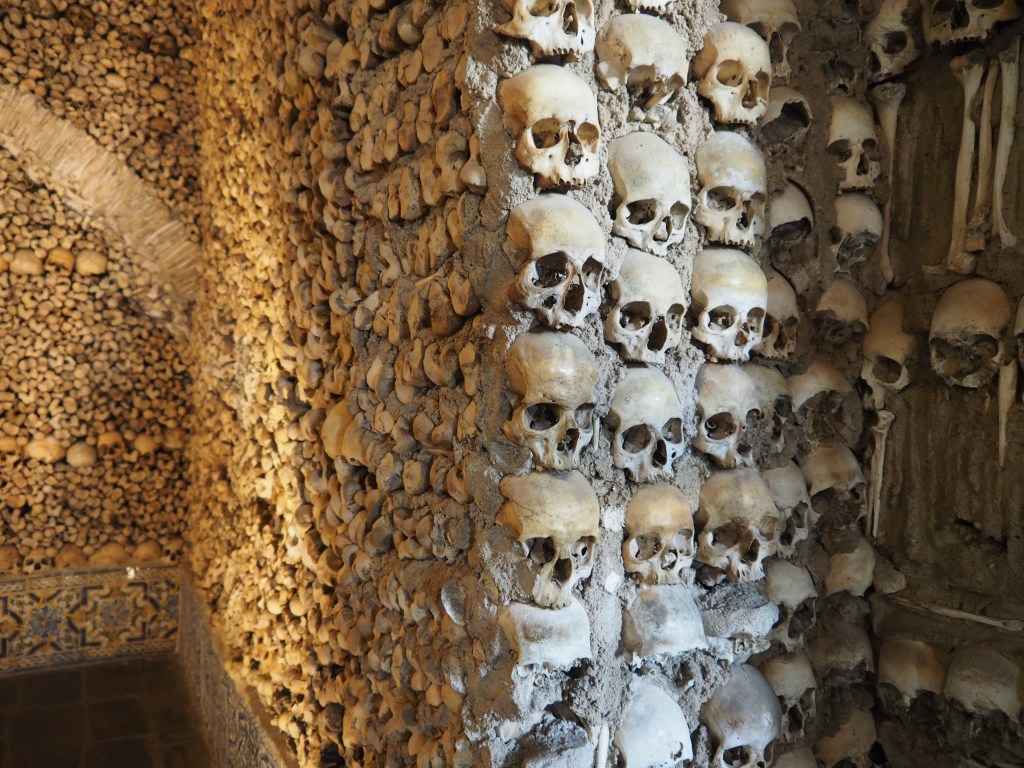
Father stops, tethered to the spot. Even his breathing is silent. Then he reels backwards, a hand out as if to save himself. At first in the gloom the walls seem to be patterned with wondrous ivory domed sea-shells. Even the vaulted ceiling and columns are covered. At intervals, long, thin shells fan outwards from a core as if they are starbursts.
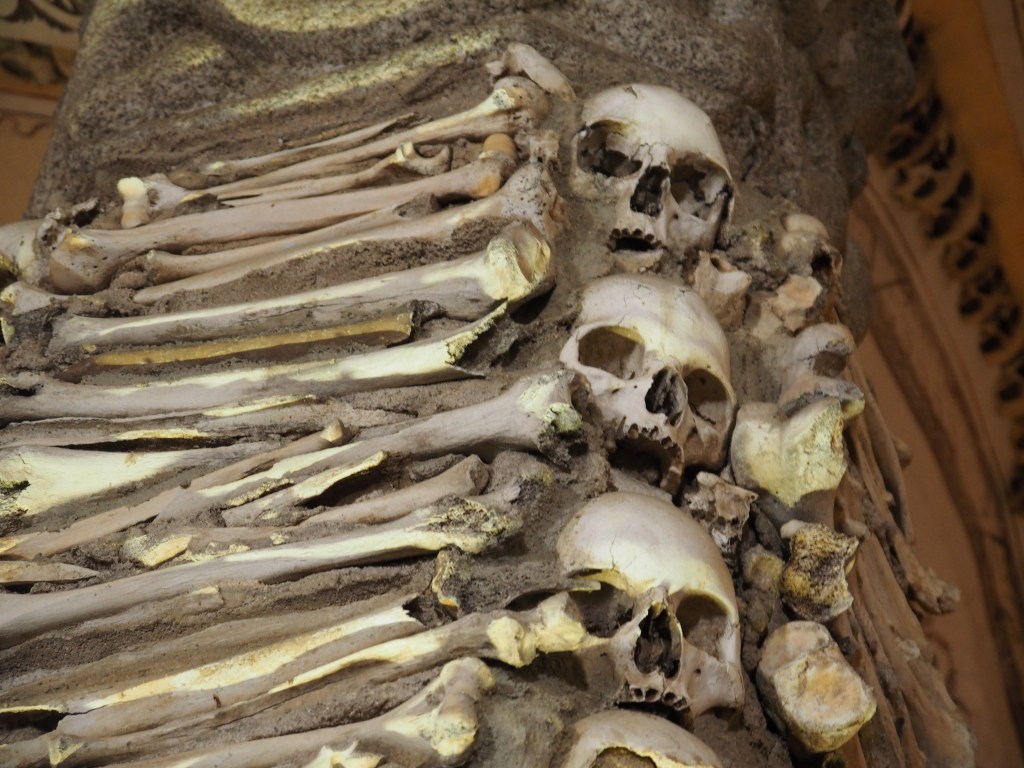
But when Brother Francisco holds the lamp up, it shines on skulls, so many skulls. As it lights up the the long thin shells the bones from arms and legs come into sharp relief. The crypt is decorated in human bones – every bit of it.
“We need an epithet above the door,” says Brother Francisco. His sharp green eyes are focussed on Father. “Do any ideas occur to you, Your Grace?”
The words stream out of me as if they have a life of their own. “We bones that are here await yours.”
Brother Francisco nods and smiles. “Your son may not parse Latin so well, but he is wise, Your Grace.” His voice is soft. “This is where we are headed from the day we are born.”
In the chapel, the priest intones, Father whispers. Prayers – my palms sweat. He is praying. No longer his aloof, silent self during mass.
Outside the sunlight is warm after the chill of the marble chapel. Father leans against a pine tree, the graveyard’s newly turned soil just over the wall.
Through the window, Antonio’s head is bent over his Latin again in the study.
Dust puffs up under Father’s footsteps. His head lowered. His words are faint on the breeze. “I leave my son and the shepherd’s boy to your guidance, Brother.”
How I did it:
This story arose from our visit to Évora’s Chapel of Bones, where skulls, tibias, and fibulas line the walls in extraordinary patterns. Noticeboards remind us of the brevity of our life-spans. They prompt us therefore to consider what is important to us.
Time passing, the fragility of our existence and concepts of eternity have always fascinated us humans and is the stuff of much literature, philosophy, medicine and science. I know my next statement could be seen as bleak, but it seems to me that from the minute we’re born, we are dying. However, this insight could encourage us to grasp opportunities with open arms as this exact day will never come again.
The translation of the quotation above the chapel door resonated so much with me: “We bones that are here await yours.” To me, this is asking us to value each day. It is also a reminder that no matter how much wealth or power we have, we are all heading in the same direction.
These were my philosophical musings which suggested a story based on status, wealth, and an inter-generational conflict. The 17th Century setting dictated my language use. It was also necessary to use a few accurate scene setting details, such as the quills and parchment, but I attempted to use just enough to suggest the era and setting.
As always with me, my first draft ‘told’ too much to the reader and directed their thoughts too much. In subsequent drafts I used the concept of zooming out as if I was filming, to give a wide-lens view of the setting and then zooming in for a close up, to ‘show’ the characters’ range of emotions.
If you want to have a go:
- Think of a point of conflict between two characters from different generations.
- Think of a metaphor which could be used to symbolise the growing awareness and change which comes about in one of the characters. For example, I’ve used the chapel of bones to show the father’s dawning awareness that his son is much wiser than he is himself.
- Use the Zoom-out and Zoom-in technique from filming to set the time and place and to ‘show’ the characters’ emotional journeys.
 campervanbard
Leave a comment