
Good Friday 2023 in Lelin-LaPujolle
Vines crucified on wires, yet new leaves uncurl
fresh to the world – a gust of wind could shiver
them to the ground, a sudden frost could shrivel
the new life in them. But for now the sun
strokes them until they stretch. Awake, hopeful,
they reach towards the coming day.
The news on my phone, touches me here, far from home,
Good Friday, twenty-five years ago, a signed treaty
weapons down – frost-burnt – on middle ground.
Along this country lane, between hazel woods
and meadows of cuckoo flower, sweet-pea vetch
a mink shoots – the tail of a mouse hangs from his mouth
in a thin strip of grey as the mink runs
between the lines of wire-strung vines.
How it came to be:
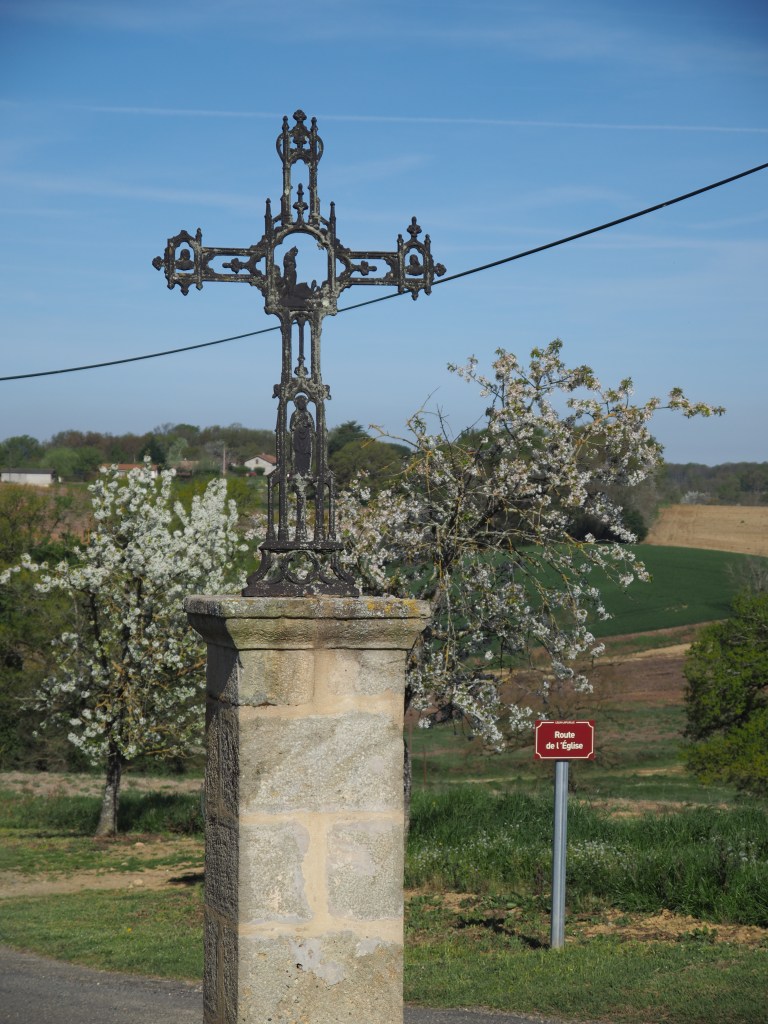
Checking in on the news from our camp site at Lelin-Lapujolle in the Midi–Pyrenees, I read Fintan O’Toole’s article on the Good Friday Agreement in The Guardian where he discusses the dangers of Brexit to peace in Northern Ireland.
I wasn’t aware that this article was chugging away in the recesses of my mind as we rambled around the country lanes until I saw the vines, their arms extended and tied to wires – for all the world like a crucifixion. This is a pure example of my own upbringing and those long Good Friday masses, and Maundy Thursday stations of the cross, impacting on my thought processes, leading me to such an interpretation of the strung-up vines.
A person from a different cultural context would interpret what they see in a totally different way. The interplay between the writer’s culture, the text itself, which when created takes on a life of its own, and the reader’s cultural context is what makes the creative process so interesting and dynamic.
I got my trusty co-rambler, Seán, to look up the name of the meadow flowers we came across on his plant identification app because I always forget the names of wild flowers, plants and trees. I was astounded at the flowers’ fragile beauty.
When a mink shot across from the woods to the meadows, the poem’s concept flashed into my head and so, in this village, a long way from Northern Ireland, Fintan O’Toole’s article, the meadow flowers, the vines and the mink became entwined.
But, of course, every poem written can trace poetic influences from published poets, and I think subconsciously Gillian Clarke’s ‘Scything’ is an influence here, especially in terms of the detailed ‘eye’ on nature, as she describes ‘the crown of the hawthorn’, the ‘willow warbler’, yet ‘Scything’ is not just about the natural world – in some ways it could be seen as documenting our intrusion into it. ‘I wade forward with my scythe/…There is stickiness on the blade/ Yolk on my hands’. Clarke invests the natural world with our demands. It is this blending of what our senses tell us about our environment and our ethical position in it which I think influenced my poem.
As well as this, though, Clarke’s gaps and silences influenced me, as I have a terrible habit of hammering points home, which is pretty effective in examination essays, but is too blunt an instrument for poetry. My constant struggle is in trying to balance what is said, with the gaps which invite the reader in. I am not happy yet with the balance in my poem and will, no doubt, in the future return to it to redraft yet again. However, I see my poetry as a journey, each one sitting on the train tracks, the destination not yet reached.
This environment in rural France emphasises the importance of getting outside and rambling around for me. It is essential to my creative process. Dickens walked London in a compulsive manner, from morning to night, and I often think rambling was one of the major feeders of his imagination.
I wrote the poem quickly, on our picnic stop en-route to Spain in the little red notebook that I carry everywhere. Notebooks are another essential to the creative process for me – some are beautiful artefacts in themselves, which I use a fountain pen to write in, just for the sheer sensory delight of the smooth, good quality pages and the pen gliding over them. Others, such as my little red notebook, are cheap and the only criteria for choosing them is that they can fit into a pocket.
As I wrote the first draft, I realised that the poem had been ‘cooking’ in my head all through our drive along mountain roads. Once down, I drafted it in fits and starts, even altering aspects of it at the very last minute before posting it. I know that if I look at it in a week, I’ll probably want to change yet more aspects of it, as it is ‘missing something’ for me, which I will have to ponder upon, but because I have a tendency to squirrel work away, I decided to publish anyway.
If you want to have a go:
- Choose a news item that means a great deal to you.
- Go for a walk – it can be close to home, a city park, a street, along a river, in a crowded city market, in the countryside, whatever suits you.
- Take a notebook with you or use your phone for recording.
- Note the plants, creatures, trees you come across. Use an identification app to find out what they are. I happen to like the common names for plants. My partner, Seán, being a scientist, likes the Latin names.
- Note any odd occurrence (with me, it was the mink.)
- Mull these things over and see if any connection or irony appears. Cook the poem in your head as you do other things, such as a workout, dancing or cooking or just sitting and watching the world go by.
- Bash out a first draft. Don’t worry about perfection. Only you can see it at this point and you can work on it later. James Joyce took ten years to edit his Ulysses, so don’t for a second think you have to produce something stunning on the first write-up.
- Enjoy the process. It’s a workout for the brain and leaves you more relaxed after it.
Of the Truth of Wild Things…
Past the silver-stunned olives, sun blasts the rough track
as it winds up the mountain, through scrub and scree,
the willow basket heavy as a child on her hip.
Halfway up the mountain, an open wound,
crater-gouged, air full of tongue-dust.
Up past sour-wine-stink from the guard’s shack,
up past the black spider webbed iron crucifix
tattooed on a bald blue sky. There he is…
shoulder-hunched, knuckle-bleached
on the hod handle, his shadow splayed on the dust.
The half-built fortress squats above, looks down
on him as, weighed down, he climbs up to it.
His calloused hand a fond graze on her cheek
before he unpacks the earthen ware bottle, drinks,
the glisten of water on the side of his chin.
The heat of his mouth on her mouth
from the offered bottle neck. “You too. Drink,” he says
and the cool water washes the dust from her throat.
Bumble bee-buzz from the rosemary scrub,
goat’s cheese, olives, and two-day old bread-crunch before
he shoulders his limestone load again.
She takes the leeward path down, past the hermitage
reclining in the mountain-cleft. Blessed shade
and grass-sweet sleep finds her there. She wakes
just feet away, fern-swept, a stag stands,
his horns just growing. He stares into her eyes
as the shadow of the fortress creeps over him.
How it came to be:
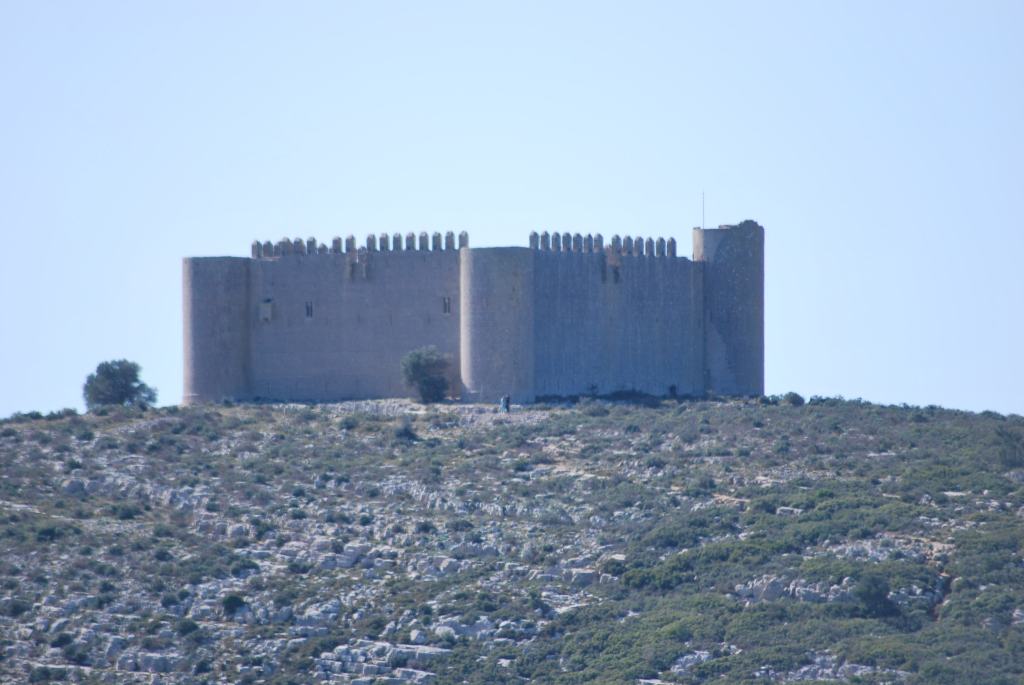

The influence for this narrative poem came from the castle which we love to climb up to in Catalonia’s Torroella de Montgri. The castle was never finished, but quarrying for the limestone, and building, went on for years in the 13th Century. And the whole reason for it? Local wars between powerful dukes for control of the land.
The climb is through rosemary, scrub, cistus and over rough limestone paths, past an ironwork cross, old guard houses. But the leeward side of the mountain falls away to an area surrounded by mountains, housing this hidden monastery. On our way to the monastery we came across the mountain deer.
My poem was definitely influenced by the environment. Place has a very powerful effect on me, especially when my feet are standing on the footsteps of people from the past. I’m always interested in how human lives intersect with nature and impact nature, so that’s an element too.
Some may claim that everything we write is influenced by our personal history and my writing certainly is. I come from a family of builders. My father emigrated to Britain after the war and was one of the many unknown men who rebuilt London and a raft of new towns after the decimation of World War II.
My mother came to England as a servant and a seamstress. So, in most situations, it is the workers who call to me across the years. The hod-carrier and his wife called to me up at Torroella de Montgri, but it was also the beautiful young deer I saw in the shadow of the hulking fortress.
But there’s always a literary influence chugging away in the background too. In this case, Carol Ann Duffy’s ‘The World’s Wife’ anthology, which has long been a favourite of mine. In ‘Anne Hathaway’ I like the way that she foregrounds the imagined emotions of Shakespeare’s wife. ‘I hold him in the casket of my widow’s head/as he held me upon that next best bed.’ This foregrounding of those in History’s background resonates with me, and so I focussed on the hod-carrier and his wife.
However, the style of my poem is much more narrative than Duffy’s and many could criticise it for this, I think, as it does not engage the intellect in the same way as Duffy’s poem does, whereby she’s writing as much about the power of words and poetry as she is about Anne Hathaway. ‘…My lover’s words/were shooting stars which fell to earth as kisses…’
Perhaps the last line of my poem, regarding the shadow of the fortress creeping across the young stag, allows some thematic considerations on the reader’s part, intimating perhaps at the encroachment of armaments and power hungry rulers on the innocent. However, I would say that there isn’t a cohesive thematic message in my ‘Of the Truth of Wild things’ and that is less than ideal. Again, though, the work is on a journey and this is merely its first stop.
If you want to have a go:
- Visit a site steeped in history.
- Soak up the atmosphere and note small details of the environment.
- Keep your eyes open for any interesting disturbance of the scene. In my case it was the appearance of the mountain deers.
- Imagine a snapshot of the life of a character from the past with a connection to the site.
- Consider the angle and viewpoint you wish to pursue.
- Combine these elements into notes and a first draft.
 campervanbard
Leave a comment